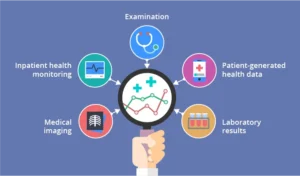
Healthcare data analytics and reporting consulting is what U.S. hospitals and health systems need when their EHR is generating enormous volumes of clinical and operational data that nobody is actually using to make decisions. If your leadership team is still relying on manually pulled spreadsheets, inconsistent department reports, and lagging indicators that are always two weeks behind — your organization has a data problem that is costing you.
Every modern EHR platform produces a rich stream of patient, clinical, operational, and financial data. But data sitting in a database is not insight. Insight is what happens when the right data is structured, surfaced, and delivered to the right decision-maker at the right time. That process requires strategy, technical expertise, and clinical context. It does not happen automatically when you go live on Epic or Oracle Health.
Zaamaa Consulting provides healthcare data analytics and reporting consulting for health systems across the United States that are ready to turn their EHR data into a genuine operational asset — not just a compliance requirement.
Why Most Health Systems Are Underusing Their EHR Data
The data problem in U.S. healthcare is not a shortage of data. It is a shortage of infrastructure, expertise, and strategy to make that data usable. Here is what we see consistently across health systems that engage Zaamaa for data analytics support:
- Reports that take days to produce manually. When operational leaders need data to make a staffing, throughput, or quality decision, waiting days for a manually pulled report means decisions get made on instinct instead of evidence.
- Dashboards that nobody trusts. When different departments pull the same metric and get different numbers, leadership stops trusting the data entirely. Inconsistent definitions, duplicate records, and broken data feeds are almost always the culprit.
- EHR reporting tools that require specialized training nobody has. Epic Reporting Workbench, Oracle Health – Operational Reporting, and MEDITECH Analytics are powerful — and almost universally underutilized because the internal team was never trained to use them effectively.
- Regulatory reporting that absorbs all available analytics capacity. When your analytics team is fully consumed by CMS quality measure reporting and Joint Commission preparation, there is nothing left for operational improvement or strategic decision support.
- No connection between clinical data and financial performance. Length of stay, readmission rates, care variation, and pharmacy costs all have direct financial implications. Health systems that cannot connect their clinical data to their financial data are making revenue cycle and strategy decisions blind.
Health systems that lack structured data analytics and reporting capabilities consistently underperform on value-based care contracts, quality benchmarks, and operational efficiency metrics compared to those with mature analytics programs.
What Healthcare Data Analytics and Reporting Consulting Covers
Zaamaa’s healthcare data analytics and reporting consulting is not a generic BI implementation. It is a healthcare-specific analytics service built around the clinical, operational, and regulatory realities of U.S. health systems. Here is what it covers:
EHR Reporting Build and Optimization
Most health systems have significant untapped reporting capability inside their existing EHR. Zaamaa’s analytics team builds and optimizes reports within Epic, Oracle Health, MEDITECH, and Sunquest — delivering the clinical and operational visibility your leaders need without requiring an additional BI platform. This work is tightly integrated with our EHR Implementation & Optimization services to ensure reporting infrastructure is built correctly from the start.
Operational Dashboards and KPI Development
Zaamaa designs and builds operational dashboards that give department leaders, nursing supervisors, pharmacy directors, and C-suite executives real-time visibility into the metrics that drive their decisions — ED throughput, OR utilization, medication turnaround, readmission rates, staffing ratios, and more. Every dashboard is built around the decisions it needs to support, not around what the technology can produce by default.
Quality and Regulatory Reporting
U.S. health systems face an expanding landscape of mandatory quality reporting requirements — CMS quality measures, HEDIS metrics, Joint Commission standards, and state-level reporting mandates. Zaamaa builds the automated reporting infrastructure that satisfies these requirements accurately and efficiently, freeing your analytics team to focus on improvement rather than compliance overhead.
Population Health and Value-Based Care Analytics
As U.S. health systems transition from fee-for-service to value-based care models, the ability to identify high-risk patients, track care gaps, and measure intervention effectiveness becomes a financial imperative. The Office of the National Coordinator for Health IT has documented the direct connection between health data infrastructure and value-based care performance. Zaamaa builds the analytics layer that makes population health programs measurable and manageable.
Data Governance and Quality Improvement
Analytics is only as reliable as the data behind it. Zaamaa establishes data governance frameworks that define how clinical and operational data is collected, validated, standardized, and maintained across your EHR and connected systems — so your leadership team can trust what the dashboard says.
5 Signs Your Health System Needs Data Analytics and Reporting Consulting Now
- Your quality scores are declining and you don’t know why. If your CMS star ratings, HEDIS scores, or readmission penalties are moving in the wrong direction and your team cannot identify the root cause from available data, your analytics infrastructure is failing your clinical leadership.
- Department heads are using different numbers in the same leadership meeting. When your CMO and your CFO pull the same metric and get different answers, trust in data collapses — and decisions revert to politics and instinct. This is a data governance and reporting infrastructure problem.
- Your analytics team spends most of its time on ad hoc report requests. An analytics team that is permanently reactive — responding to one-off requests rather than maintaining a strategic reporting program — is a symptom of missing infrastructure, not a staffing shortage.
- You are entering a value-based care contract with no population health analytics capability. Signing a value-based contract without the analytics infrastructure to measure performance, identify care gaps, and track intervention outcomes is accepting financial risk you cannot see coming.
- Your EHR has been live for more than a year and your standard reports still require manual cleanup. Data quality issues that persist beyond the first year post-go-live are not self-correcting. They require a structured data governance and reporting optimization engagement to resolve.
Every one of these situations is fixable. Healthcare data analytics and reporting consulting gives your organization the infrastructure, the governance, and the analytical capacity to turn your EHR data into a competitive and clinical advantage.
How Analytics Connects to Your Broader Healthcare IT Strategy
Data analytics does not operate in isolation. The quality of your analytics output is directly determined by the quality of your EHR configuration, your system integrations, and your clinical workflows. Here is how Zaamaa’s analytics consulting connects to the rest of your healthcare IT environment:
- Clinical Informatics: Poorly designed clinical workflows produce poor-quality data. Zaamaa’s Clinical Informatics team ensures that the clinical documentation feeding your analytics is structured, consistent, and clinically meaningful.
- System Integration: Analytics that only pulls from your EHR misses critical data from lab systems, pharmacy dispensing, imaging platforms, and financial systems. Zaamaa’s System Integration services create the data pipelines that make enterprise analytics possible.
- Go-Live Support: Reporting and analytics infrastructure built before go-live — not retrofitted after — produces better data quality from day one. Zaamaa embeds analytics planning into every Go-Live Support engagement.
Healthcare IT Staffing: If your organization needs a dedicated data analyst, reporting specialist, or BI developer on a contract basis, Zaamaa’s Healthcare IT Staffing model places credentialed analytics professionals rapidly